
You’re Not Lazy. You’re Not Broken. You’re Not Weak.
If you’re a man who’s been feeling numb, unmotivated, or emotionally flat for a while now, there’s a good chance you’re not depressed in the way most people think. You’re not sad. You’re not crying. You’re not even feeling much of anything—and that’s the problem.
What you’re experiencing may be a deeply wired safety response, rooted in biology and survival—not just a serotonin imbalance.
The Hidden Crisis: Why Male Depression Goes Unrecognized
The statistics paint a troubling picture. While men are diagnosed with depression at half the rate of women, they die by suicide at four times the rate. This isn’t because men are inherently more vulnerable to suicide—it’s because we’re missing the signs of male depression entirely.
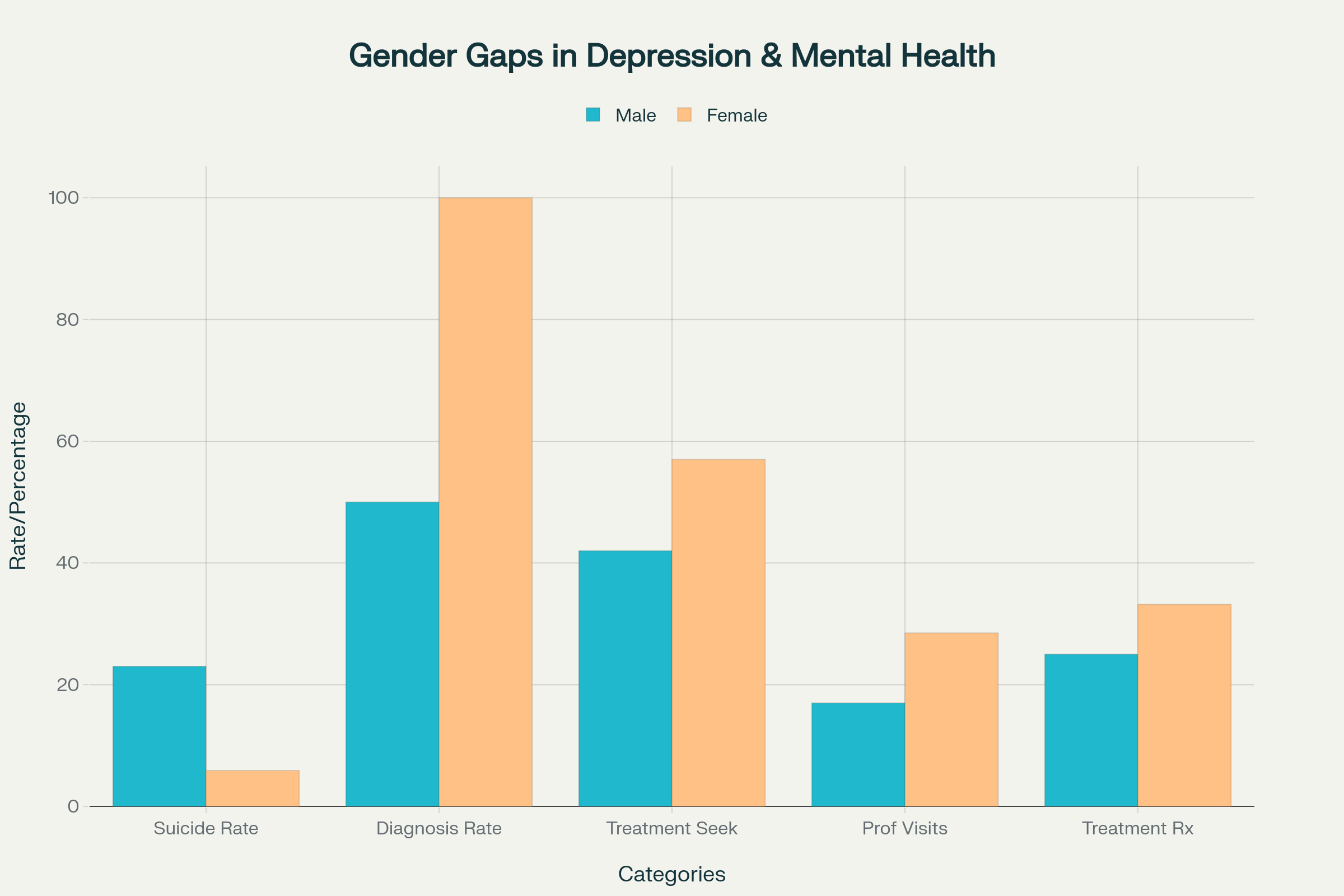
Research shows that men with depression often exhibit “male-typical” symptoms that don’t fit traditional diagnostic criteria: irritability, anger, substance use, risk-taking behavior, and emotional numbness. These externalized symptoms are frequently dismissed as character flaws rather than recognized as depression.
Depression as a Safety Strategy: The Biology of Shutdown
Many men enter what clinicians now call “functional freeze”—they go to work, pay the bills, and show up where expected, but internally, they feel nothing. No fire. No spark. Just fog, fatigue, and the low hum of disconnection.
This isn’t just a mood issue. It’s a nervous system response. When the body has been under stress for too long—whether from chronic overwhelm, trauma, or unmet emotional needs—it does something adaptive: it shuts down. Like a blown fuse, your body is trying to conserve energy to keep you safe.
According to Polyvagal Theory, when neither fight nor flight feels possible, the nervous system activates the dorsal vagal response—a state of immobilization and emotional numbing. If you had more energy, more would be expected of you. If you felt more, you might break. So instead, your body goes numb.
The Biopsychosocial Framework: Understanding the Full Picture
Predisposing Factors: The Seeds of Shutdown
The pattern often begins in childhood, particularly in environments where emotional expression was punished or ignored. Research indicates that boys who grow up in households where “being strong meant being silent” are more vulnerable to developing depression later in life.
High-functioning perfectionism serves as psychological armor, but it comes at a cost. Recent studies show that perfectionism is significantly linked to increased susceptibility to major depressive disorder, particularly in men. The relentless pursuit of flawlessness creates psychological pressure that can eventually overwhelm the nervous system.
Precipitating Factors: The Breaking Point
Major life transitions hit men particularly hard because they often lack the emotional scaffolding to navigate uncertainty. Loss of purpose—whether through retirement, relationship breakdown, or career plateau—can trigger a depressive episode. Unlike women, who are more likely to seek social support during transitions, men often suffer in isolation.
Chronic stress, burnout, and unresolved grief create a perfect storm for nervous system dysregulation. When the autonomic nervous system is constantly activated, it eventually leads to what researchers call “allostatic load”—the cumulative wear and tear on the body.
Perpetuating Factors: The Cycle of Shame
Traditional masculinity ideologies (TMI) create significant barriers to healing. The shame of not feeling “manly” or “motivated” keeps men trapped in isolation. This creates a vicious cycle: the more isolated they become, the more their symptoms worsen.
Cognitive rigidity—the belief that “if I don’t feel like it, I can’t do it”—becomes a self-fulfilling prophecy. Many men receive inadequate treatment because clinicians focus solely on pharmacological interventions without addressing the underlying nervous system dysregulation.
The Path Forward: Trauma-Informed, Body-Based Healing
Nervous System Regulation: The Foundation of Recovery
Research consistently shows that depression is associated with autonomic nervous system dysregulation, specifically reduced parasympathetic activity. Effective treatment must address this biological reality through body-based interventions:
Breathwork: Controlled breathing exercises can help regulate the nervous system and release stored trauma
Movement therapy: Dance/movement therapy has shown significant improvements in depression symptoms by helping men reconnect with their bodies
Heat therapy: Emerging research suggests that sauna use may help regulate body temperature and improve mood
Restoring Micro-Agency: Small Steps, Big Changes
The concept of “micro-agency” involves identifying small, manageable actions that restore a sense of control and self-efficacy. This might be as simple as taking a five-minute walk, practicing deep breathing, or completing one small task. These micro-interventions help rebuild the neural pathways associated with motivation and self-worth.
Male-Specific Psychotherapy: Meeting Men Where They Are
Recent developments in male-tailored psychotherapy show promising results. These approaches recognize that men may need different therapeutic frameworks that:
Address gender role conflict directly
Use psychoeducation to normalize the experience
Incorporate physical and somatic interventions
Focus on practical skills and concrete outcomes
The Science of Hope: Evidence-Based Interventions
Studies on trauma-informed care consistently show better outcomes when treatment addresses both the psychological and physiological aspects of depression. Somatic approaches, which work directly with the body’s stress responses, have shown particular promise for men who struggle with traditional talk therapy.
Research on vagal tone—a measure of nervous system health—indicates that improving parasympathetic function can significantly reduce depression symptoms. This can be achieved through various interventions, from meditation and yoga to specific breathing techniques and cold exposure.
Moving Beyond Stigma: A New Understanding
It’s time to reframe male depression not as a personal failing, but as a natural response to overwhelming stress. When we understand numbness as information rather than pathology, we can begin to address the root causes rather than just the symptoms.
The goal isn’t to eliminate all difficult emotions, but to restore flexibility to the nervous system—the ability to feel deeply when it’s safe to do so, and to protect when necessary.
Take the Next Step
If this resonates with your experience, know that you’re not alone. Depression in men is real, treatable, and nothing to be ashamed of. The numbness you’re experiencing isn’t a sign of weakness—it’s your body’s way of protecting you until you can find a safer way to engage with life.
Ready to begin your healing journey? Schedule a consultation today and let’s start reconnecting you to yourself—on your terms. You deserve support that understands both the biology of depression and the unique challenges men face in seeking help.